Pebblecrete vs quartz and the other pool surfaces
No single surface is best for every pool. Which one suits yours depends on the shell, whether the pool is salt or chlorine, how long it can be out of use, who gives the warranty and what the contractor applies well. The table sets pebblecrete vs quartz, plaster, paint, tile and fibreglass side by side, using the words the sources use and saying where they stop.
Names need care. Finishes are sold under names such as Quartzon and Marblesheen, and we found no neutral definition of either name. Ask the contractor which product is meant, and ask for its data sheet.
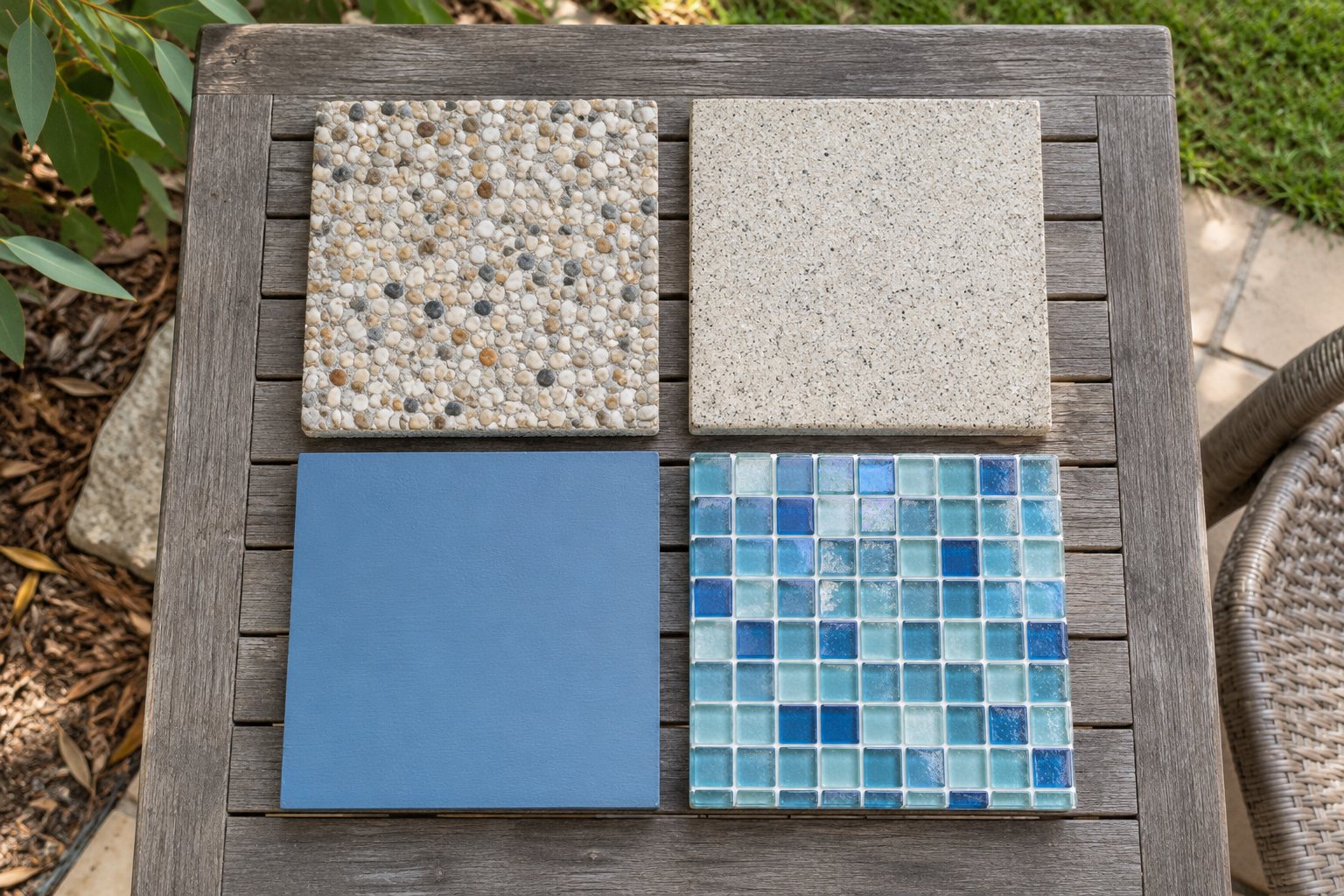
The surfaces side by side
| Finish | What it is, as sources describe it | What sources say about wear and care | What to ask |
|---|---|---|---|
| Cement render and plaster | Cement mixed with sand or limestone, per one trade magazine. Trade sources also describe white cement with white sand or marble aggregate and water. | One epoxy guide says the quality of surfaces such as Marblesheen and Quartzon "varies widely" with raw materials, application, additives and deterioration. | Which product, how hollow areas are handled and what the written start-up steps are |
| Pebble and pebblecrete | Plaster with added aggregate, per a trade magazine. A coatings maker says it is hand-trowelled, so installer skill affects the look and the wear. | The maker lists common ageing signs: random cracks, worn areas, black and rust staining, calcium build-up, hollow areas and sharp or loose pebbles. | Who lays it, how the surface is finished and what happens if pebbles loosen |
| Quartz | A trade magazine says exposed quartz removes the cement cream to show silica aggregate. One South African data sheet describes a dry-powder pool render applied in a thin layer and acid washed the next day. | The same data sheet asks for no automatic cleaner for three weeks and brushing only. That is one product. | Which product, whether its data sheet is Australian and how start-up is handled |
| Paint and coatings | Chlorinated rubber is single-pack and solvent-based. Acrylic is waterborne. Epoxy is two-pack. One acrylic sheet describes a thin film. | A trade magazine says paints are non-structural and unsuitable for cracked or leaking pools. Epoxy and acrylic sheets say the coatings do not bridge moving cracks. | Which product class, whether it suits your water and what recoating involves |
| Tile | One consumer publisher calls tile a premium finish. We found no technical source, so we make no claim about its wear. | As a general point, one consumer guide says tiling does not fix an underlying structural problem. | Who tiles, what is under the tile, and slip resistance (we found no standard for it) |
| Fibreglass | A resin layer on a fibreglass shell. A trade magazine describes hand-applied and spray-applied linings. | The same magazine names fibre bloom, water ingress and osmosis as failure risks. A consumer guide calls a new layer smooth and low maintenance. | What is under the existing finish, how leaks and osmosis are checked and which product is used |
Rows are summaries of what sources say, not rankings. The pebblecrete and quartz page covers how those two are applied, the painting and epoxy page covers coatings, and the fibreglass page covers shells. Tile sits with the renovation and retiling page.
Why published lifespans disagree
Ranges published by makers and trade publishers differ widely, from a few years to a couple of decades, and depend on water chemistry, use and installation quality. We give no figure, because the sources do not agree and no neutral Australian source settles it.
The disagreement has reasons. Makers and publishers describe different products. Some write marketing, some write for trades and some report one job. One regional council's news item, for example, describes a heated pebblecrete lining that was patched repeatedly before an engineer advised full replacement, which is a single lining and not a rule (regional council news item). One manufacturer's page says unbalanced chemistry can weaken the cement so that pebbles loosen, and says loose pebbles during the initial curing period are normal (manufacturer's page, origin not stated). Ask for the data sheet and the written warranty terms, and ask who gives them.
Salt water pools: what to ask
Whether a surface suits a salt water pool depends on the product. One chlorinated rubber data sheet from a New Zealand maker says it is not suitable for heated, salt water or spa pools (data sheet). One epoxy care guide allows salt to be added after the initial filtering (care guide). Other sheets we read do not mention salt. We found no neutral Australian source on salt water and plaster wear.
So the useful question is not which surface suits salt, but whether the product being offered does, and where that is written. Ask the contractor for the sentence on the data sheet. Salt also matters at emptying time: another council's sewer fact sheet says the council may set acceptance limits for total dissolved solids from salt-water pools (another council's fact sheet). Coffs Harbour's own rule for emptying a residential pool was not found, so ask Coffs Harbour City Council. The draining page explains.
How to decide: questions, not a verdict
These questions narrow the choice more reliably than any ranking.
- What is the pool finished with now? Some data sheets say a product is unsuitable over existing epoxy or fibreglass, and others need a sound base.
- Is the shell sound? A hollow area or a moving crack can rule out a thin coating, per the sheets above. The signs guide shows what to look for.
- Salt or chlorine? Ask where the data sheet addresses it.
- How long can the pool be out of use? Fill delays differ between products. See the timing guide.
- How is the pool used? Tell the contractor if the pool is heated, and ask whether the data sheet says anything about heating or use.
- Who gives the warranty, and what does it depend on? Warranties often depend on following the start-up instructions, so ask for them in writing.
The cost guide shows how those answers feed into a quote.
What a comparison cannot do
It cannot tell you which finish to choose. The sources we read are manufacturer data sheets, trade magazines, a council news item and consumer publishers, and each describes its own products. We found no neutral Australian test comparing the finishes, and no source that ranks them for Coffs Harbour conditions.
Use the table to ask sharper questions. Then ask each contractor to name the product, give the data sheet, state the warranty terms in writing and say what is under your existing finish.
Check the current rules before you rely on this
This page describes how published sources characterise pool finishes and does not rank them or recommend one. It describes the rules in general terms as they stood in November 2026. Standards, forms, thresholds and fines change.
The authoritative sources are Pool and Spa Marketing, best practices for completing concrete pool interiors (trade magazine, 2017, country inferred as Canada), AccomNews, pool surface options (trade magazine, undated), Industrysearch, pebblecrete pools and upgrading (coatings maker's article, flag: marketing), Luxapool, general pool care guide for epoxy coated pools (VER1901), APCO Coatings, Poolkote chlorinated rubber pool paint product data sheet (2017) and Central Coast Council, swimming pool and spa liquid trade waste fact sheet (example of what a sewer authority may require). Where anything here differs from those sources, they are right and we are not.
We are not pool contractors, builders, regulators or lawyers. For what applies to your job, ask the contractor which licence or certificate they hold and check it on the NSW licence check, then ask Building Commission NSW (13 27 00). Ask Coffs Harbour City Council about emptying the pool, registration and the pool barrier, and SafeWork NSW about dust and chemicals.
Accurate at the time of writing, November 2026. Always check the source before relying on it.