Do you need a licence to resurface a pool in NSW? What the pages say
This page sets out what NSW Government pages say about the pool resurfacing licence in NSW, and what they leave out. We quote short fragments and give the date of the main page, so you can check them yourself. We are a referral service. We pass your enquiry to a local contractor. Contractors carry out all work and are responsible for any licence or certificate that applies, and this site makes no claim about any contractor's licence.
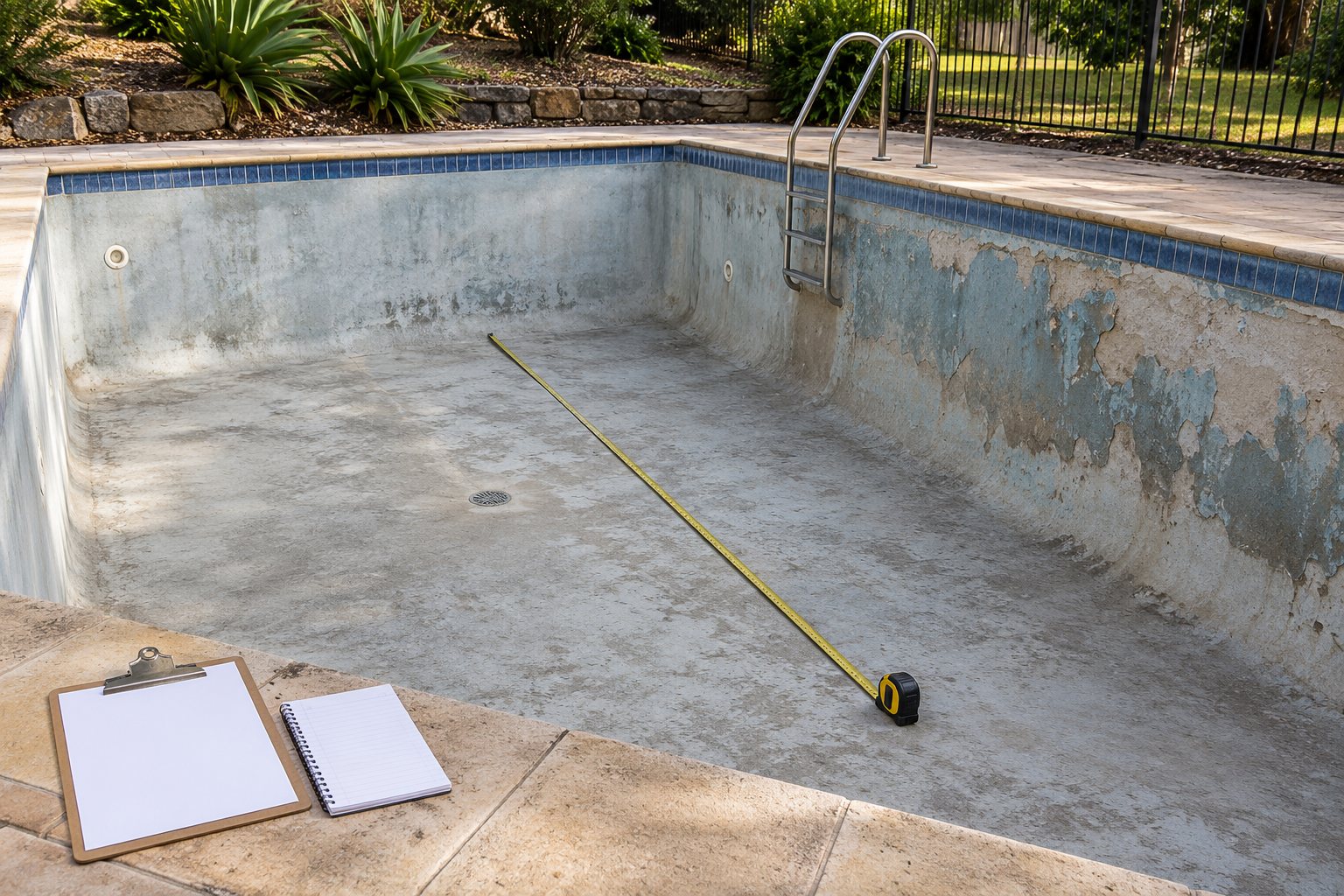
The NSW Government's swimming pool repairs and servicing work page (page last updated 23 June 2026, per the page) opens with: "You must have a licence or certificate to do swimming pool repairs and servicing work." It defines the category as work to fix or maintain parts of an existing swimming pool. The category includes non-structural additions, changes and repairs, "painting and surfacing (rendering or applying surface coatings) of a swimming pool", and acid washing and pool cleaning. It excludes work related to paving, decking, landscaping or fencing for a pool or spa.
In plain terms: NSW Government pages list pool surfacing and surface coatings inside the swimming pool repairs and servicing category and say a licence or certificate is needed for that category. Check the contractor's licence category and expiry on the NSW licence check and ask Building Commission NSW on 13 27 00 if you are unsure.
The same page says a contractor licence is needed to carry out, advertise or contract for building or trade work valued at more than $5,000 in labour and materials including GST. Where a licence is needed, it gives penalties of $22,000 for an individual and $110,000 for a company. It lists individual contractor licences, company or partnership contractor licences and a qualified supervisor certificate, with terms of one, three or five years.
Two categories exist. The NSW categories of work page lists swimming pool building under other building work and swimming pool repairs and servicing under trade work. The swimming pool building work page describes that work as including construction, renovation, alteration, repair, extension and maintenance, and "decorative or protective treatment" of a swimming pool.
What the pages do not say
The gaps matter as much as the wording, so we state them plainly.
- The pages do not map any particular finish, such as pebblecrete, quartz, tile, fibreglass or epoxy, to a category, and neither do we. The repairs and servicing page does not mention tiling, relining or structural work.
- They do not say which category a mixed job needs, such as a new surface with tiles, coping and structural repairs.
- They do not say whether the $5,000 figure is measured per contract or per job when separate trades are used.
- They do not say whether Home Building Compensation, which applies above $20,000, or statutory warranties apply to pool surfacing.
- They do not explain how the certificate differs from the licence for the person on site and for the business.
We do not fill these gaps with a guess. If anyone tells you a particular finish or job sits outside the licence rules, ask them to show you the wording on a NSW Government page, and ask Building Commission NSW. The pebblecrete and quartz page and the renovation and retiling page describe the work. Neither says which category it falls under.
How to check a contractor before you sign
- Ask which licence or certificate the contractor holds, in which category.
- Check it on the NSW licence check. The NSW contractor check page says it shows the holder's name, licence numbers, categories and expiry.
- Get more than one written quote. The same page says so in those words.
- Do not pay any money without a written contract.
- If you are unsure, call Building Commission NSW on 13 27 00, Monday to Friday 8:30am to 5pm, excluding public holidays.
Written contracts and deposits
The figures below are from the NSW building contracts page. They apply if the work counts as residential building work, and the pages we read do not say whether pool surfacing does.
| Contract detail | What NSW Government pages say, if the work counts as residential building work |
|---|---|
| Over $5,000 including GST | A written contract is required. |
| From $5,000 to $20,000 | The work must be covered by a small jobs contract. |
| Over $20,000 | Home Building Compensation cover is required. It is illegal for the contractor to ask for a deposit or other payment under the contract until cover is taken out and the certificate given. |
| Deposit | The maximum deposit is 10 per cent. |
| Over $20,000: contract terms | The contract states a five clear business day cooling-off period and includes a progress payment schedule. |
| Changes | Variations must be in writing and signed by both parties. |
| Your copy | The signed contract copy must be given within five business days. |
Ask the contractor and Building Commission NSW whether these rows apply to your job before you rely on them. The cost guide covers the quote checklist that sits beside the contract.
Warranties, disputes and time limits
NSW Government pages describe statutory warranties of six years for major defects and two years for other defects, for contracts signed on or after 1 February 2012. They do not say whether these apply to pool surfacing, so ask your contractor and Building Commission NSW whether they apply to your job.
The NSW resolving building disputes page lists the steps: review the contract, talk to the contractor, confirm in writing, contact Building Commission NSW and, where there is insurance, notify the Home Building Compensation insurer in writing. A complaint can be lodged at a Service NSW centre.
Building Commission NSW says to try the contractor first. It says proceedings to the Tribunal must start within six years of completion for major defects and two years for other defects, with an extra six months if a breach is discovered in the last six months. It is the owner's responsibility to apply before the period ends, and the Commission cannot order either party to resolve the complaint (building defect complaints page). Keep the contract, the quote, photographs and your messages in one place.
Manufacturer warranties and the contract checklist
Product warranties are separate from statutory ones, and they differ. One epoxy application guide for pebblecrete says the manufacturer cannot supervise application and gives no warranty on suitability for a particular purpose, and says statutory rights are not excluded (epoxy coating guide for pebblecrete). One pebble manufacturer's page describes a dual arrangement: the product from the maker and the workmanship from the applicator. One acrylic coating sheet limits liability to a refund of the purchase price if a written claim is made within 14 days of delivery (acrylic coating sheet).
Warranties often depend on following the start-up instructions, so ask for them in writing and read the start-up guide. Ask who gives each warranty and what it requires.
SPASA, an industry body and not a regulator, says a contract should include plans or scope, start and completion dates, the total price and provisional sums, a payment schedule, a variations process, who handles permits and site access, workmanship and product warranties, proof of insurance, a clean-up commitment, handover documents, and how disputes are resolved (SPASA contract page). SPASA cannot step into disputes. The draining, dust and barrier page covers the other rules to raise with the contractor.
What this page cannot do
It cannot tell you whether your job needs a licence or certificate, which category applies, whether the contract thresholds apply or whether statutory warranties cover it. It summarises NSW Government pages as they stood in November 2026, quotes short fragments and states where the pages are silent. It is not legal advice.
We make no claim about any contractor's licence, insurance or warranty. Ask the contractor, check the NSW licence check and call Building Commission NSW on 13 27 00 if you are unsure.
Check the current rules before you rely on this
This page describes what NSW Government pages say about licences, contracts and warranties for pool surfacing, and where they are silent. It describes the rules in general terms as they stood in November 2026. Standards, forms, thresholds and fines change.
The authoritative sources are NSW Government, swimming pool repairs and servicing work (licence page), NSW Government, swimming pool building work (licence page), NSW Government, categories of building and trade work, NSW Government, checking your contractor or tradesperson is qualified, NSW Government, building contracts and home building compensation and Building Commission NSW, building defect complaints. Where anything here differs from those sources, they are right and we are not.
We are not pool contractors, builders, regulators or lawyers. For what applies to your job, ask the contractor which licence or certificate they hold and check it on the NSW licence check, then ask Building Commission NSW (13 27 00). Ask Coffs Harbour City Council about emptying the pool, registration and the pool barrier, and SafeWork NSW about dust and chemicals.
Accurate at the time of writing, November 2026. Always check the source before relying on it.