Draining pool water in Coffs Harbour: what we found
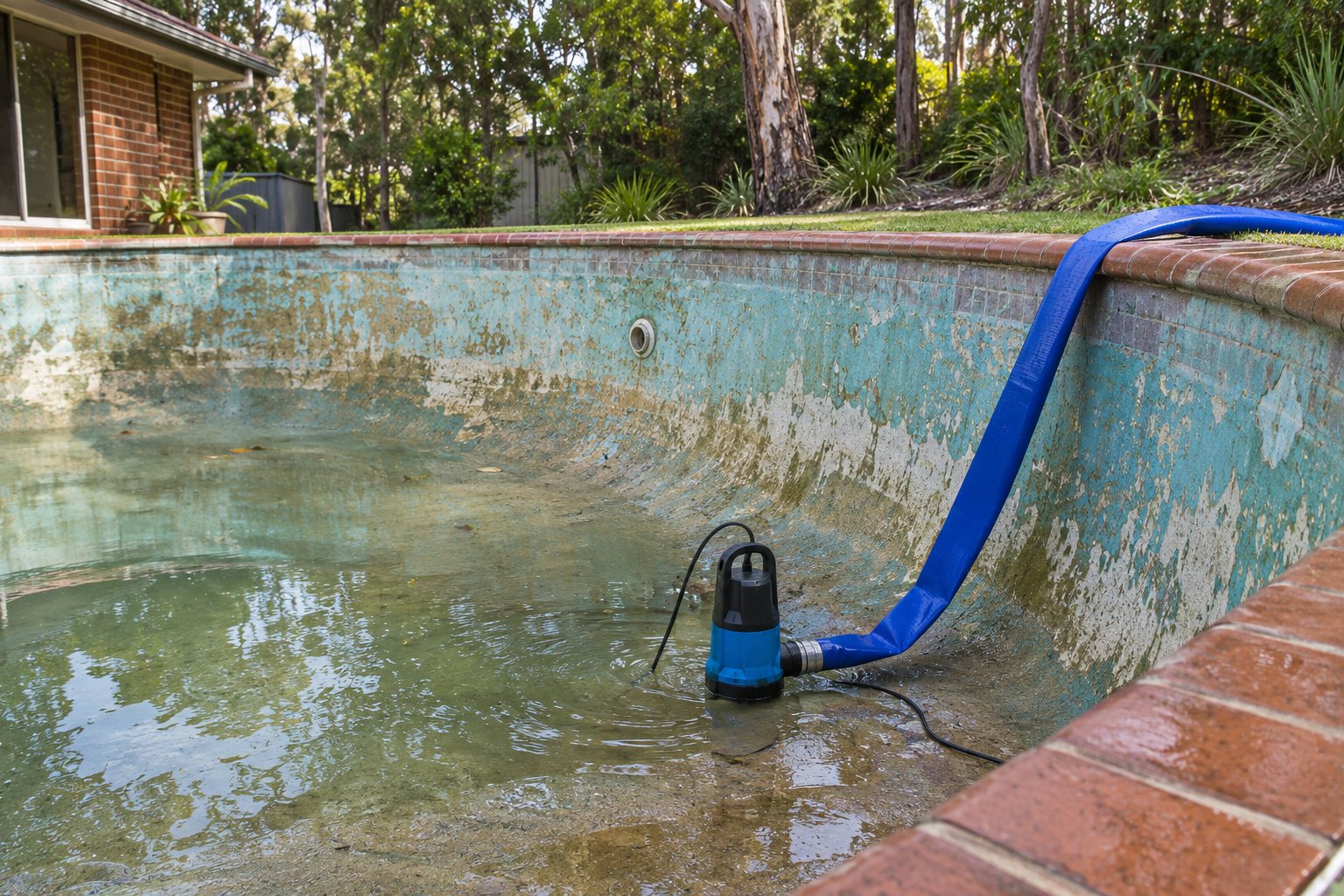
Pool water, backwash and slurry should not go to the stormwater drain. Councils and sewer authorities set their own rules for emptying a pool; ask Coffs Harbour City Council before the pool is emptied. Concrete and cement slurry is a pollutant under NSW law. This page covers draining pool water, dust and the pool register, and says where we found nothing. We are a referral service. The contractor carries out the work and is responsible for any licence or certificate that applies.
Coffs Harbour City Council's liquid trade waste procedure (PRO-093, approved 10 October 2023) excludes "residential swimming pool backwash" from liquid trade waste. It treats non-residential pools as a classification A, charging category 1 activity and water treatment backwash as classification C. Trade wastes need written approval before discharge to the sewer, and approvals are not transferable. Roof, rain, surface, seepage or ground water must not go to the sewer "unless specifically permitted".
The document does not address emptying pool water, chlorine, salt, concrete or slurry. We have not found Coffs Harbour's rule for emptying a residential pool, so we do not state one. The council's swimming pool approval and safety page covers new pools and the register, and does not mention repairs, resurfacing or draining. Ask council before the pool is emptied. Ask your contractor who contacts council, where the water goes and how slurry is collected.
What other councils say, as examples only
None of the following is a Coffs Harbour rule. These sources show what a sewer authority or council may require, so you know what to ask.
| Source, described | What it says |
|---|---|
| Another NSW council's pool and spa sewer fact sheet (fact sheet) | Notify the council before emptying. The council sets a controlled flow rate to the sewer. Do not empty during wet weather. The council may set acceptance limits for total dissolved solids from salt-water pools. Wash water from cleaning with strong detergent or acid must not go to the sewer. |
| A second council's water pollution fact sheet (fact sheet) | Backwash must not enter the drain and stormwater system. It cites section 120 of the Protection of the Environment Operations Act 1997, which makes it an offence to cause or permit the pollution of any waters. Fines exist. |
| A third council's dewatering brochure (brochure) | Get council permission before pumping into the stormwater system, and do not let cement, slurry, soil or other building materials enter any waterway. It is not about chlorinated pool water, so it is used for the principle only. |
| A fact sheet from a group of councils on cutting concrete (fact sheet) | Only rainwater may enter the stormwater system. Concrete slurry should go to a lined area, a skip or a recycler. |
We give no fine amounts, since they differ by council and by offence. Salt matters here: if the pool is salt water, ask whether dissolved solids limits could apply. The finish comparison covers salt compatibility of products.
Dust and chemicals: silica rules when concrete is ground or chiselled
Silica controls are required when cutting or grinding concrete; ask how dust is controlled. SafeWork NSW lists wet dust suppression and on-tool extraction as controls, masks to Australian Standards fit tested when starting and every 12 months, and a workplace exposure standard for respirable crystalline silica of 0.05 mg/m3 averaged over 8 hours (SafeWork NSW silica page). Its construction checklist lists grinding, polishing, jack hammering or chiselling of concrete or masonry as high-risk activities, and the code of practice lists angle grinding or jackhammering of concrete among the processes it covers.
None of these pages mentions pools. Our reading is that pool resurfacing often involves removing an old finish by chiselling, grinding or blasting, so the controls could be relevant, but whether a particular job is covered is for the contractor and SafeWork NSW. We publish no silica percentage and make no pool-specific claim.
Chemicals need care too. Manufacturer guides call for acid etching and neutralising, and two chlorinated rubber data sheets describe their products as flammable or needing ventilation. We found no SafeWork NSW page on pool acid handling. Another council's fact sheet says acid wash water must not go to the sewer, so ask where it goes.
The NSW Swimming Pool Register: every pool, including spas
Coffs Harbour City Council's page says all pools, including spas, must be registered on the NSW Swimming Pool Register. The ABLIS entry for pool registration names the Swimming Pools Act 1992 and the Swimming Pools Regulation 2018 (ABLIS entry); we have not read the Regulation text. After registration, an inspection by council or an accredited certifier can lead to a compliance certificate, which is valid for three years while the barrier is unchanged. Fees exist, and we give none.
The Swimming Pool Register information page says selling needs a certificate of registration plus a certificate of compliance, an occupation certificate or a certificate of non-compliance. Leasing needs registration plus a certificate of compliance or an occupation certificate. Landlords and agents should check the pool's status before a lease starts.
The pool barrier, renovations and which standard applies
The Register page says that if the pool barrier is modified or altered, which "may include house and yard renovations", the current Act, Regulation and AS 1926.1 apply and previous exemptions no longer apply. SPASA, an industry body and not a regulator, says existing pools can keep the standard they were built under unless the barrier is substantially changed (SPASA barrier rules overview).
Which edition of AS 1926.1 applies is unsettled in the pages we read. The Register page names the 2012 edition. One other council's FAQ describes a 2024 edition as the latest, with an anticipated transition date of 1 May 2027 (council FAQ). Ask council or the certifier which applies on the day.
Resurfacing alone is not addressed on these pages. Our reading, and not an official statement, is that a job which removes, relocates or alters fencing, gates or coping near the barrier may bring the barrier rules in. Ask council or a certifier when the barrier or access is touched. The renovation and retiling page covers coping and tiles.
Who to ask at Coffs Harbour City Council
Telephone 02 6648 4000. The council page says the number can be used at any hour if the matter is urgent. Email coffs.council@chcc.nsw.gov.au. The Customer Service Centre is at Yarrila Place, Level 1, 27 Gordon Street, Coffs Harbour, open Monday to Friday 9.00am to 3.30pm. The postal address is Locked Bag 155, Coffs Harbour NSW 2450.
The council is the same whichever suburb the pool is in: central Coffs Harbour, Sawtell, Toormina and Boambee East, Woolgoolga or Korora and Moonee Beach. For the licence side, read the licence, contract and warranty page, and for the steps themselves the process guide.
What this page cannot do
It cannot tell you what Coffs Harbour City Council requires to empty your pool, whether resurfacing triggers any register action or inspection, or whether a particular job is covered by the silica rules. We did not find council pages on these points, and other councils' fact sheets are examples only. We are not the council, SafeWork NSW or a certifier.
Ask the council before the pool is emptied, ask the contractor how water, slurry and dust are handled, and ask council or a certifier when the barrier or access is touched.
Check the current rules before you rely on this
This page describes what Coffs Harbour City Council, NSW and SafeWork NSW pages say about draining, dust, the pool register and the pool barrier, and where they are silent. It describes the rules in general terms as they stood in November 2026. Standards, forms, thresholds and fines change.
The authoritative sources are Coffs Harbour City Council, swimming pool approval and safety requirements, Coffs Harbour City Council, liquid trade waste procedure (PRO-093, 2023), NSW Swimming Pool Register, information, SafeWork NSW, work safely with crystalline silica and engineered stone and Central Coast Council, swimming pool and spa liquid trade waste fact sheet (example of what a sewer authority may require). Where anything here differs from those sources, they are right and we are not.
We are not pool contractors, builders, regulators or lawyers. For what applies to your job, ask the contractor which licence or certificate they hold and check it on the NSW licence check, then ask Building Commission NSW (13 27 00). Ask Coffs Harbour City Council about emptying the pool, registration and the pool barrier, and SafeWork NSW about dust and chemicals.
Accurate at the time of writing, November 2026. Always check the source before relying on it.