Why does pool pebblecrete fail? Water gets under the surface
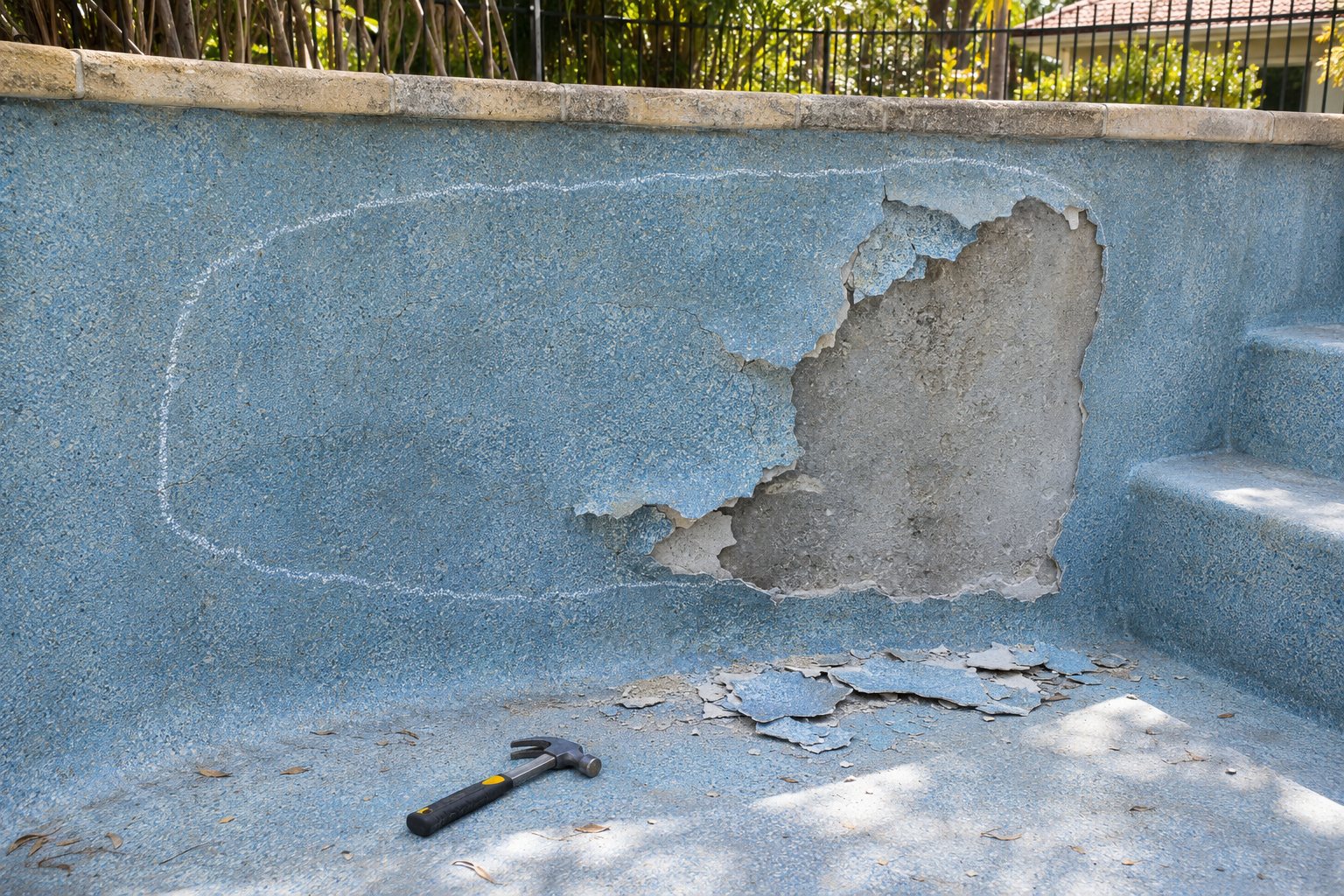
The clearest account we found comes from one regional council's news item on a heated pebblecrete lining. It says water gets under the coating as the surface deteriorates, causing more of it to flake off. Patching failed, and the engineer advised full replacement (regional council news item). That is one lining, not a rule for every pool, but it shows how a small failure can spread once water gets behind the finish.
The rest of this page sets out the causes sources name. They overlap, and a pool can have more than one. The signs guide covers what each failure looks like from the pool edge.
Water chemistry and installer skill
A coatings maker lists pool water chemistry, general wear and installation quality among the causes of ageing in pebblecrete, and says it is hand-trowelled, so installer skill affects the look and the wear (coatings maker's article). A trade magazine adds two points: metals in fill water can come out of solution and permanently blemish the finish, and under extreme chemical swings even pebble surfaces can deteriorate (trade magazine article). One manufacturer's page says that if chemistry is not balanced the cement may weaken and pebbles may come loose in larger amounts (manufacturer's page).
We publish no chemistry targets. Care guides give different targets for different products, and a number for one system can be wrong for another. One epoxy care guide says low alkalinity is likely to cause early coating degradation (epoxy care guide). Follow the sheet for the product used, and ask for it in writing.
Poor preparation and the wrong base
Several failures trace back to what was left under the new finish. The trade magazine says hollow areas must be removed before re-plastering and deep ones filled, and that leftover paint or fibreglass must be ground or blasted off before new plaster. It also names calcium scale from plaster dust. An epoxy guide says no coating goes over unsound surfaces: if more than 10 per cent of the pool area is unsound, the old finish comes off and the shell is treated as new (epoxy guide for Marblesheen and Quartzon surfaces). One chlorinated rubber data sheet says its product is not suitable over existing epoxy or fibreglass.
The common thread is that the new finish is only as sound as its base. That is why the process guide puts sounding and repair before any coat.
Moving cracks, rust and fibreglass failure modes
Coatings do not repair a shell that moves. Two data sheets, one acrylic (acrylic coating sheet) and one epoxy (epoxy pool coating sheet), say their coatings do not bridge moving cracks or joints. The chlorinated rubber sheet says structural cracks over 3 mm and leaks need professional assistance (chlorinated rubber data sheet). The coatings maker adds that rust staining coming from below calls for treating the corrosion in the pool's structural steel, not just the stain.
Fibreglass shells fail in their own ways. A 2014 trade magazine article, whose country we could not confirm, names fibre bloom, water ingress and osmosis, poor workmanship and unsuitable materials (trade magazine article on fibreglass). Australian fibreglass recoating data was not found, so the fibreglass page asks questions and does not give figures.
Salt, groundwater pressure and the weather
Salt. Whether salt harms a surface depends on the product. One chlorinated rubber sheet says it is not suitable for heated, salt water or spa pools. One epoxy care guide allows salt after the initial filtering. Other sheets do not mention salt, and we found no neutral Australian source on salt water and plaster wear. Ask for the sentence on the data sheet.
Groundwater pressure. Hydrostatic pressure is a general risk when a pool is emptied, because water in the ground can push on an empty shell. It is not a Coffs Harbour finding, and we found no groundwater data for the Coffs Coast. Ask the contractor how they manage groundwater pressure when the pool is emptied.
Temperature and weather. One epoxy guide says low temperatures at application can cause accelerated chalking. Coffs Harbour's rain and humidity matter to the application window, because data sheets ask for dry surfaces and rain-free days, but they are context and not a cause of failure. We make no claim about salt air. The painting and epoxy page sets out the limits by product type.
What to ask a contractor
| If the concern is | Ask |
|---|---|
| Water getting under the finish | How is the old finish tested, and are patches or full replacement proposed? Why? |
| Chemistry | Which written start-up and care instructions come with the product, and what do they depend on? |
| Preparation | How are hollow areas found and removed, and is any old paint or fibreglass taken off? |
| The base | What proportion of the surface is unsound, and at what point is everything removed? |
| Moving cracks | Does the product bridge movement, per its data sheet? Is the crack structural? |
| Salt | Where does the data sheet address salt water pools? |
| Emptying the pool | How is groundwater pressure managed, and where do the water and slurry go? |
The pebblecrete and quartz page covers how that finish is applied. See the draining page for where the water goes.
What a failure guide cannot do
It cannot say why your pool surface failed. Causes overlap, and many are visible only once the pool is empty and the surface has been tapped, tested and measured. The sources are a coatings maker, manufacturer data sheets, a trade magazine and a council news item, and each describes its own products.
Treat the causes as questions for the contractor. They decide what is wrong, what must be removed and whether a repair or a new finish is proposed, and they should explain their reasoning in writing.
Check the current rules before you rely on this
This page describes the causes of pool surface failure that manufacturers and trade sources name, and does not diagnose any pool. It describes the rules in general terms as they stood in November 2026. Standards, forms, thresholds and fines change.
The authoritative sources are Fraser Coast Regional Council, news item on a new pebblecrete lining for a heated pool (undated), Industrysearch, pebblecrete pools and upgrading (coatings maker's article, flag: marketing), Pool and Spa Marketing, best practices for completing concrete pool interiors (trade magazine, 2017, country inferred as Canada), Luxapool, general pool care guide for epoxy coated pools (VER1901) and Coating Technologies, Epotec NT epoxy pool coating data sheet. Where anything here differs from those sources, they are right and we are not.
We are not pool contractors, builders, regulators or lawyers. For what applies to your job, ask the contractor which licence or certificate they hold and check it on the NSW licence check, then ask Building Commission NSW (13 27 00). Ask Coffs Harbour City Council about emptying the pool, registration and the pool barrier, and SafeWork NSW about dust and chemicals.
Accurate at the time of writing, November 2026. Always check the source before relying on it.